f you missed our brilliant Part 1 of Busting Website Accessibility Myths, do check it out. Here, we carry on with 4 more website accessibility myths to bust.
Myth #5: “Overlays and ‘AI widgets’ make my site compliant.”
Those little “dudes in a circle” icons you see in the corner of websites?
They are a ratty band-aid, not a cure—and sometimes, they’re the band-aid that rips the skin off. Many screen reader users find these overlays intrusive or glitchy.
Real accessibility happens in the code, not in a third-party plugin that tries to “mask” the problems.
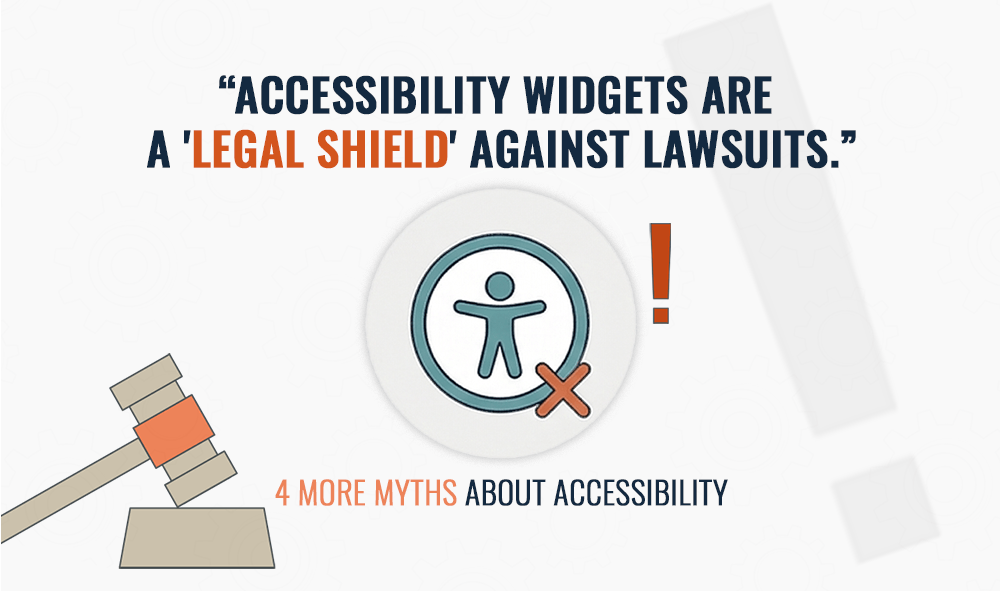
Myth #6: “Accessibility widgets are a ‘legal shield’ against lawsuits.”
This is perhaps the most dangerous, and expensive in the form of a lawsuit, myth of all.
Many companies buy these widgets thinking they are an insurance policy. They see the “ADA Compliant” badge in the marketing and think they’re safe from a “shakedown.”
The reality? In 2025, over 25% of all ADA website lawsuits were filed against companies that already had a widget or overlay installed.
In some cases, the widget itself was cited as the barrier.
Lawyers who specialize in accessibility lawsuits actually look for these widgets because they are a giant neon sign saying: “We know we have accessibility issues, but we tried to take a shortcut instead of fixing them.”
True legal protection doesn’t come from a $50-a-month plugin; it comes from doing the work to make your actual code inclusive.
Myth #7: “We’ll just fix accessibility after the site launches.”
This is the digital equivalent of building a skyscraper and trying to add the elevator shafts after the roof is on.
Sure, you can do it, but it’s going to be messy, expensive, and twice as much work.
Accessibility is a foundation, not a fresh coat of paint.
When you bake it into your design phase, it costs less and works better.
Myth #8: “Accessible is a one-and-done project.”
The web is alive.
Every time you post a new blog, add a product, or update a plugin, you’re changing the landscape of your site.
Accessibility, just like other aspects of your site like updates and security, is ongoing for the life of your site. But by building in accessible practice that are used every day rather than just doing a once-a-year audit and fixes, you can maintain a high level of ongoing accessibility without a lot of work.
True inclusion is a practice, not a destination.
At the end of the day, myths are just stories we tell ourselves to avoid doing the work.
But as mission-driven businesses, we don’t run from the work. We embrace it.
Website accessibility isn’t a legal “gotcha”—it’s a social justice issue. It’s a design challenge. It’s a way to prove that your “People over Profit” values aren’t just a footer on your homepage.
Let’s make the web a place where everyone is invited to the party!