

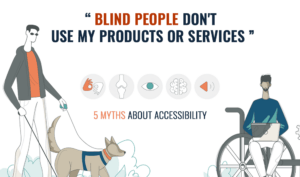
Busting Website Accessibility Myths: Part 1
Let’s be real: Most people think website accessibility is a boring “check-the-box” legal chore. They’re wrong. In fact, the myths floating around the digital space are actually preventing some of the world’s best mission-driven brands from reaching the people who need them most. We’re here to bust the ghost stories and get back to what matters—equal access for everyone. Myth #1: “Our target audience doesn’t have disabilities.” This is the big one. And it’s a total fabrication. Roughly 25% of adults in the U.S. live with some form of disability and have a frustrating experience using the web. Think: ADHD, dyslexia, autism, epilepsy, colorblindness, low vision, deafness and more. If you think a quarter of your potential supporters don’t exist, you’re not just missing out on impact; you’re leaving your community behind. Accessibility isn’t for a “niche” group—it’s for humans. Myth #2: “Ok, maybe some people with disabilities use our
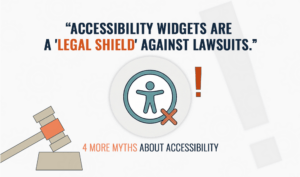
Busting Website Accessibility Myths: Part 2
If you missed our brilliant Part 1 of Busting Website Accessibility Myths, do check it out. Here, we carry on with 4 more website accessibility myths to bust. Myth #5: “Overlays and ‘AI widgets’ make my site compliant.” Those little “dudes in a circle” icons you see in the corner of websites? They are a ratty band-aid, not a cure—and sometimes, they’re the band-aid that rips the skin off. Many screen reader users find these overlays intrusive or glitchy. Real accessibility happens in the code, not in a third-party plugin that tries to “mask” the problems. Myth #6: “Accessibility widgets are a ‘legal shield’ against lawsuits.” This is perhaps the most dangerous, and expensive in the form of a lawsuit, myth of all. Many companies buy these widgets thinking they are an insurance policy. They see the “ADA Compliant” badge in the marketing and think they’re safe from a “shakedown.”
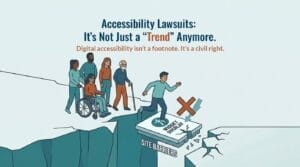
Accessibility Lawsuits: It’s Not Just a “Trend” Anymore.
Digital accessibility isn’t a footnote. It’s a civil right. And if the latest data from our friends at UsableNet tells us anything, it’s that the legal landscape is moving faster than ever. We know you care about doing the right thing. But let’s look at why doing the right thing is also the smartest move for your business in 2026. The Numbers Are Talking (And They’re Loud) In 2025, we saw over 5,000 ADA digital accessibility lawsuits filed. That’s not just a statistic. It’s a message. While New York, Florida, and California remain the “hotspots,” the legal reach is expanding. If a user in any state can’t navigate your site, the courts are increasingly saying: “That’s not okay.” Physical presence doesn’t matter anymore; your digital storefront is your front door. The “Widget” Myth is Officially Busted Can we talk about overlays for a second? Those “one-line-of-code” accessibility widgets? They aren’t
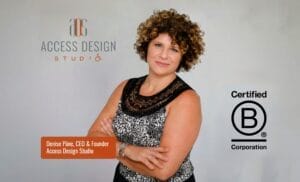
It’s Official! Access Design Studio is now a Certified B Corp™
“We are a global movement working to benefit people and the planet.” –B Corp A Milestone for Digital Inclusion At Access Design Studio, our mission has always been clear: to create equal access to the web. We believe that an inclusive digital world is a fundamental right, not a privilege. Today, we are proud to share that our commitment to social and environmental impact has been verified—Access Design Studio is now a Certified B Corporation. What it Means to be a B Corp™ B Corp Certification isn’t just a badge; it’s a commitment to a different way of doing business. B Corps are companies verified by B Lab™ to meet high standards of social and environmental performance, transparency, and accountability. For us, this certification is a natural extension of our work in web accessibility. Just as we strive to remove barriers for people with disabilities online, B Corp standards challenge

Part 3: From Bluff Charges to Digital Resilience: Your Accessible Future
(Find Part 1 of the story here. Find Part 2 here.) The lion skidded to a halt a second time. The tension in the air was so thick you could have cut it with a safari knife. Then, as quickly as he had appeared, he turned and ran off, vaporizing back into the thick Botswana bush. He was gone. My heart was hammering against my ribs, and as adrenaline flooded my body, I started to comprehend the astounding experience I had just had. The Business Lesson: Focus on the Path, Not the Panic. In those moments with the lion, I had to override primal terror and focus on Basta’s instruction. I couldn’t be distracted by heart-pounding fear. When fixing an inaccessible website, it’s easy to panic over the number of issues an audit reveals. We guide our clients to focus on the critical path—starting with the high-impact fixes (keyboard navigation,
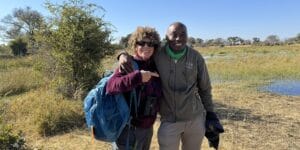
Don’t Run Part 2: Why Your Website Needs a “Basta”
100 feet. 80 feet. 60 feet. When we left off, a male lion was charging directly at me in the Okavango Delta. (Find Part 1 of the story here.) Basta fiercely whispered, “DON’T RUN!” I had my binoculars laser-focused on the lion. He was so close I could see every rippling muscle. I did not move. Not one part of my body. I was a statue with binoculars. Well, a statue whose heart was thundering in her chest. The lion skidded to a halt, raising a cloud of dust around his massive paws. Then he turned, walked around a bush, stopped on the other side, and stared straight at me. Through my binoculars, I looked directly into his golden eyes. I will never, ever forget that moment. I stared right into the golden eyes of one of the world’s fiercest predators. I felt so alive. So awed. So dazzled. He